GLP-1 Drugs and Muscle Loss: What 2025 Research Actually Reveals About Your Body Composition
The Scale Tells Only Half the Story
When you lose weight on a GLP-1 medication like semaglutide, the number on the scale drops. That part feels straightforward. What the scale doesn’t tell you is where that weight is actually coming from. With over 9 million active users of these medications in the United States by the end of 2025, this question has moved from academic curiosity to something affecting millions of real bodies making real decisions about their health.
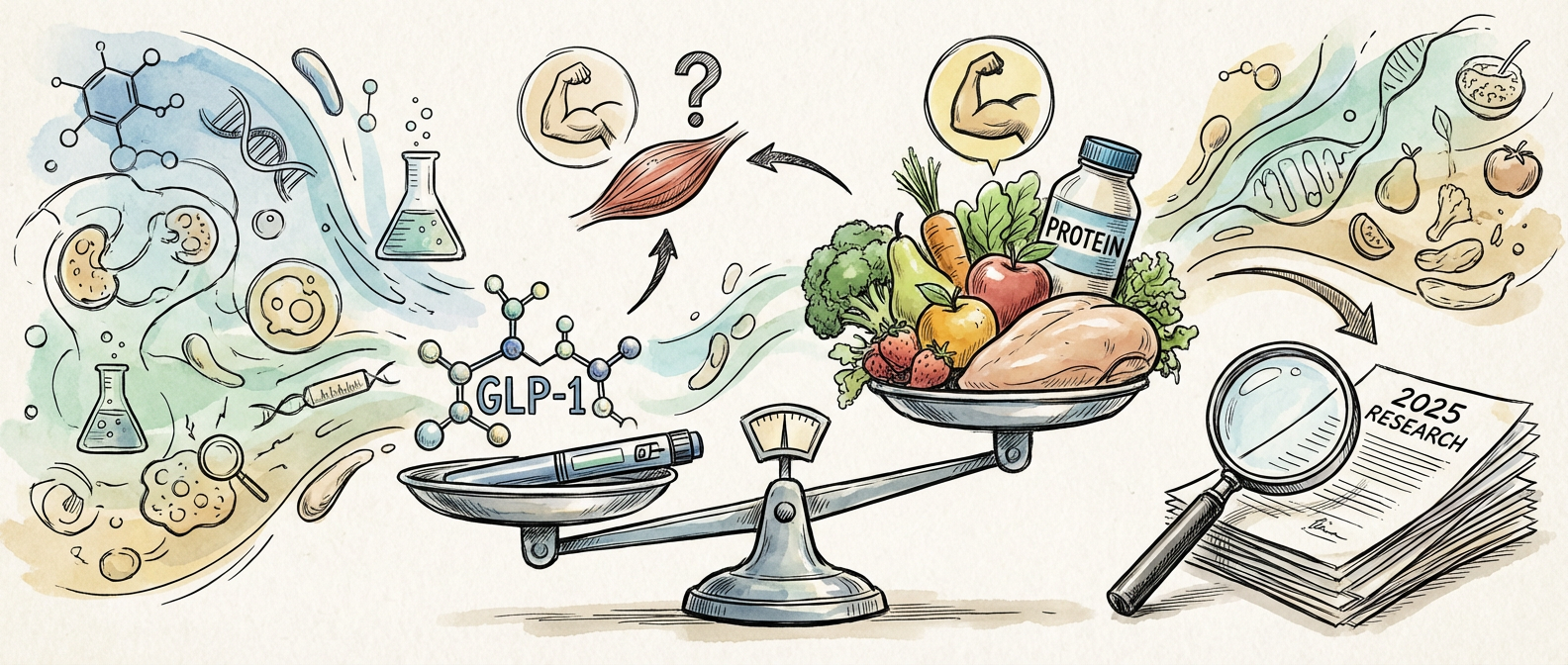
Here’s what matters: a rigorous 2025 study published in JAMA Internal Medicine found that when people taking GLP-1 medications didn’t engage in resistance training, approximately 39 percent of their total weight loss came from lean muscle mass rather than fat. That’s not a rounding error or a minor detail. That’s nearly two-fifths of your progress potentially coming from the metabolically active tissue that keeps your body running efficiently. Think of it this way: if you lose 30 pounds without resistance training, roughly 12 of those pounds might be muscle you probably wanted to keep.
This doesn’t mean GLP-1 medications are bad. It means they work differently than we initially assumed, and understanding that difference changes how we should approach using them.

Why Your Body Prioritizes Muscle Loss During Rapid Weight Loss
The body isn’t trying to frustrate you. It’s following evolutionary logic that made perfect sense when food was scarce. When you consume significantly fewer calories, your body enters what researchers call a protein-sparing adaptive phase. It preferentially uses muscle for energy because, from a survival standpoint, your organs and brain need glucose more urgently than your biceps do. GLP-1 medications accelerate calorie reduction by dramatically suppressing hunger, which can be powerful and helpful, but it also means your body faces a more acute energy deficit than it would with slower, deliberate weight loss.
What’s happening at the cellular level matters here. Muscle tissue is metabolically expensive to maintain. When your body detects sustained low calorie intake, it down-regulates muscle protein synthesis, the process that rebuilds muscle after it’s broken down during daily activity. Without the stimulus of resistance training to tell your muscles they’re still needed, your body essentially downsizes that department.
Here’s the genuinely encouraging part, though. The relationship between GLP-1 use and muscle loss isn’t fixed or inevitable. It’s modifiable through specific behavioral choices, which means you have actual agency here.
The 62 Percent Solution: What Resistance Training Actually Changes
A 2025 study from the University of Copenhagen published in Nature Medicine examined what happens when GLP-1 users add resistance training to their routine. The findings were substantial. Participants who combined their medication with weekly resistance training reduced muscle mass loss by up to 62 percent compared to those taking medication alone. That’s not incremental improvement. That’s the difference between losing 12 pounds of muscle versus losing roughly 4-5 pounds of muscle on that same 30-pound weight loss scenario.
The mechanism is straightforward but powerful. Resistance training sends a clear biological signal: this muscle is necessary. That signal triggers muscle protein synthesis even in the face of calorie restriction. Your body receives competing information. Yes, calories are limited. But also, these muscles are being actively used and stressed, so they’re worth maintaining. When that signal is strong enough, your body prioritizes keeping muscle over breaking it down for energy.
You don’t need to become a powerlifter or spend hours in the gym. The research supports consistent resistance training, typically 2-4 sessions weekly, using progressive resistance that challenges your muscles. Bodyweight exercises, resistance bands, dumbbells, or gym equipment all work. What matters is consistency and progressive challenge. Your muscles adapt to demands placed on them, and resistance training places very specific demands.
Protein Distribution: The Nutrition Piece That Actually Works
Resistance training is half the equation. Nutrition is the other half, and this is where recent research from Stanford researcher Dr. Christopher Gardner, published in early 2026, offers surprisingly specific guidance. The traditional approach to protein intake, getting your daily target whenever throughout the day, doesn’t optimize muscle retention during GLP-1 use as effectively as a more deliberate approach.
Users who distributed their protein intake across 4-5 meals throughout the day maintained significantly better body composition outcomes compared to those who front-loaded protein or consumed it in fewer, larger meals. This matters because your muscles have a window of capacity for protein synthesis. Spreading intake allows your body to maximize protein utilization throughout the day rather than having excess protein that your body simply excretes.
The Obesity Society GLP-1 Clinical Guidelines now recommend that all GLP-1 medication users aim for at least 1.2 grams of protein per kilogram of body weight daily. For a 150-pound person, that’s roughly 82 grams of protein daily. Split across 4-5 meals, you’re looking at roughly 16-20 grams per meal, which is entirely manageable. A palm-sized portion of chicken, a cup of Greek yogurt, a serving of salmon, a couple of eggs.
The practical truth is this: you can follow the guidelines perfectly on paper and still lose muscle if the timing and distribution don’t align with how your body actually processes and utilizes protein during energy restriction.
Making This Personal: What This Means for Your Decisions
If you’re considering GLP-1 medication or already using it, the research from 2025 onward tells a clear story. The medication itself is neutral on muscle loss. Your choices around it are what matter. Three variables control your outcome: the degree of calorie deficit the medication creates, your resistance training consistency, and your protein intake strategy.
You can’t control the medication’s appetite-suppressing effects perfectly, and you shouldn’t try. That’s the tool’s actual value. But you can control whether you do resistance training twice weekly or skip it. You can control whether you eat 80 grams of protein in one meal or distribute it across four meals. Those choices, made consistently, determine whether you emerge from weight loss with a faster metabolism and maintained strength, or whether you end up lighter but weaker.
This is the kind of health decision that rewards forethought without requiring perfection. You don’t need to execute flawlessly. The research suggests that even partial adherence to resistance training and protein distribution substantially reduces muscle loss compared to none. Something is dramatically better than nothing. Consistency matters more than intensity.
Have you navigated GLP-1 use or considered it? What aspects of managing body composition during weight loss feel most confusing or challenging to you? The research is changing constantly, and so are the practical strategies people discover actually work in their own lives.

Accessibility in Civic Tech Is Not a Feature—It’s the Foundation

AI’s Creative Renaissance: How Artificial Intelligence is Reshaping Art and Writing

Your Gut Feelings Might Be More Literal Than You Think: What Science Really Says About Your Microbiome and Mood
About Author
